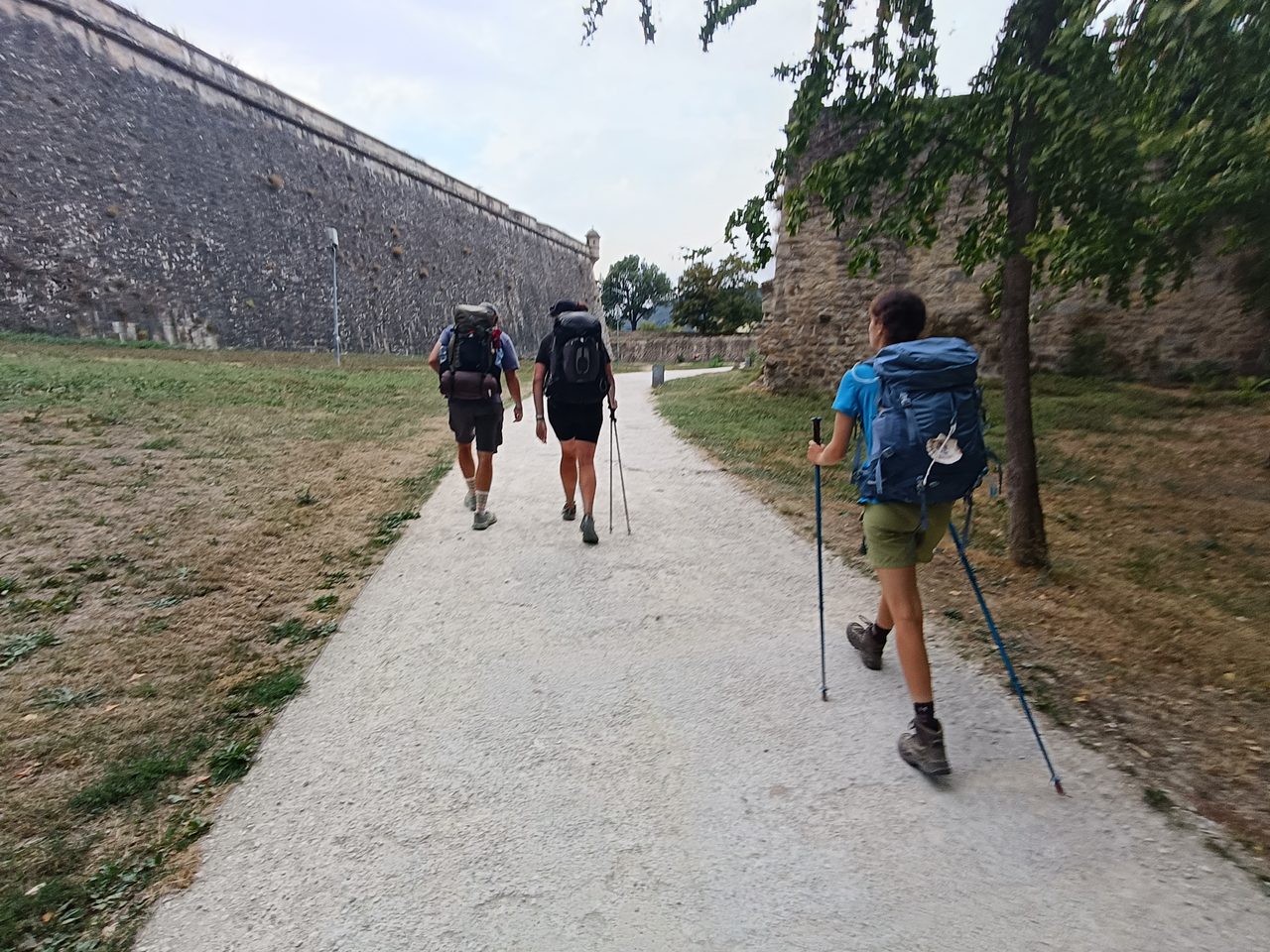
You bend down to tie a shoe, or lift a suitcase off the luggage belt, and you freeze for half a second. Is it starting again?
I know that half-second well. I’ve had low back pain since I was 30, and for ten years I arranged my winters around it. More on that at the end.
Anyone who has had a bad bout of low back pain knows the moment. The episode itself usually passes; most ordinary back pain eases within weeks. The fear that stays is a different one: that it will come back.
That fear is not irrational. Almost seven in ten people who recover from an episode of low back pain have another one within a year.
So the useful question is not only how to get over back pain. It is how to push the next episode further away. In 2024, a trial published in The Lancet tested a remarkably ordinary answer: walking.
The WalkBack trial
The trial, called WalkBack, was led by researchers at Macquarie University in Sydney (Pocovi et al., The Lancet, 2024). It was the first randomised trial to test walking for this purpose.
- Who: 701 adults from across Australia who had recovered from an episode of non-specific low back pain within the previous six months. “Non-specific” means pain with no identified cause such as a fracture, an infection or cancer. Their average age was 54, and 81% were women.
- People who knew back pain well: almost all of them (96%) had had more than two earlier episodes. The typical participant had had over thirty.
- Not already active: people who already walked for exercise three or more times a week, or met the usual physical-activity guidelines, were excluded. The trial was about people starting something new.
- Two groups, by lot: half were assigned to a walking and education programme, half to no treatment. The control group was free to seek any care they wanted.
- For a long time: everyone was followed for one to three years. Each month they reported whether their back pain had come back badly enough to get in the way of daily activities.
What the programme actually was
This part matters, because headlines that say “walking prevents back pain” leave most of it out.
- Six sessions with a physiotherapist acting as a coach: five in the first 12 weeks and a booster session at six months. The physiotherapists were trained in health coaching: asking rather than instructing, and setting goals together with the participant. During the COVID-19 pandemic many sessions moved to video calls.
- A walking plan built for each person: the starting dose depended on how much the person already walked, their age and their weight, and then on their own goals, time and surroundings. The guiding target was five walks a week of at least 30 minutes by six months, adjusted to the individual.
- A step counter and a walking diary for the first 12 weeks. The physiotherapist checked the diary and adjusted the plan.
- Education: a basic understanding of modern pain science, aimed at making back pain less frightening, plus simple strategies to lower the risk of a recurrence and to handle a minor one.
The walking itself was done by the participants on their own time. And the build-up was slower than the target suggests: in the first week, the typical participant walked on purpose for about 80 minutes over three walks. By week 12 it was about 130 minutes over four walks. That was enough.
What happened
walking programme vs no treatment
- The pain stayed away almost twice as long. Half of the control group had an activity-limiting recurrence within 112 days. In the walking group, that point came at 208 days.
- Fewer people had one within a year. By the end of the first year, about 7 in 10 people in the control group had had an activity-limiting recurrence, compared with under 6 in 10 in the walking group. Over the whole follow-up, the risk was 28% lower (hazard ratio 0.72).
- Fewer recurrences needed treatment. Recurrences that sent people to a health professional were reduced even more, and fewer people in the walking group sought other treatments, such as massage, physiotherapy or chiropractic care (37% vs 50%).
- Less disability. Back-related disability scores were lower in the walking group at every check-up during the first year.
- Good value, though not free. Delivering the programme cost about AU$414 per person, and the walking group’s total costs were a little higher. But measured against the health it bought, the researchers found it very likely cost-effective.
- Recurrences were a little milder. A follow-up analysis looked at people whose pain did come back (Pocovi et al., JOSPT, 2025). In the walking group, episodes were slightly shorter (typically 3 days instead of 4) and the worst pain a bit lower. The authors call these differences small and of uncertain clinical importance.
Why would walking help?
Exercise combined with education was already known to help prevent back pain from coming back. But most of the programmes tested were group classes with close supervision and equipment: expensive, hard to fit around work and family, and easy to drop. Walking has none of those problems. It is free, needs nothing but shoes and fits into an ordinary day.
As for why it worked, the honest answer is that nobody knows yet. The authors write that the exact mechanisms are unclear, and so is the relative importance of the walking and the education. Their best guess is that the two complement each other: education helps people overcome the avoidance and fear of movement that often follows back pain, while the coaching and the walking plan change behaviour.
One detail supports the idea that it is not just about kilometres. At three months, the walking group walked about 50 minutes a week more than the control group. By twelve months, that difference had disappeared, partly because the control group was walking more too. Yet the walking group’s advantage in recurrences did not disappear with it.
What it does not say
- It tested the whole package. Walking, education, six coaching sessions, a step counter and a diary came together. We cannot tell how much of the effect came from walking alone.
- It is about preventing a recurrence, not treating pain. Participants had already recovered. The trial says nothing about walking during an acute episode, about chronic pain, or about back pain with a specific cause.
- It did not make back pain disappear. Half of the walking group still had a recurrence within about seven months. The programme pushed the next episode further away; it did not abolish it.
- The participants knew which group they were in. The data collectors and the statisticians were blinded, but the recurrences were self-reported by people who knew whether they were walking. That is hard to avoid in an exercise trial, and the authors list it as a limitation.
- A particular group of people. Mostly women aged roughly 43 to 66, in Australia, with a long history of back pain, who were not already active. The results do not tell us about people who already walk regularly.
- Walking more has its own cost. The number of people with any adverse event was similar in both groups (52% and 54%), and the walking group had fewer back-related problems. But it had about twice as many problems in the legs and feet: 100 events in 72 people, versus 54 events in 41 people in the control group. The authors’ advice to clinicians is to progress carefully and watch for early symptoms.
The practical lesson: build it up slowly
If there is one thing to take from WalkBack beyond the headline, it is the shape of the programme:
- Start where you are. The starting point was set from each person’s current walking, not from an ideal. Three walks a week is a fine beginning.
- Grow it over weeks, not days. Participants went from about 80 to 130 minutes a week over three months. That is slow, and it was enough.
- Keep a record. A step count or a simple diary was part of the programme, and it showed when it was time to step up and when to ease off.
- Listen to your feet and knees. Leg and foot problems were the real cost of the programme. Twinges there are a reason to slow the build-up, and to get them checked if they persist.
- Pain that lingers or worries you belongs with a clinician. Especially pain that keeps getting worse, or comes with numbness, weakness or fever. This post summarises a study; it is not a diagnosis.
Your 4-week experiment
A rhythm, not a prescription. If you’ve recovered from a bout of ordinary back pain and want to walk more:
- Week 1: three walks of a length that feels easy. Write down how long each one was.
- Weeks 2 to 4: each week, either add one walk or add five minutes to each walk, never both.
- At the end of week 4, look at the diary. Are you walking more than in week 1, without your feet, knees or back protesting?
If the answer is yes, you are doing what the WalkBack participants did: building up gradually and keeping at it. That consistency, not a heroic first week, is what the trial actually tested.
My own back
For me, the trigger was always the cold. Once it got into my lower back, the back would lock up. So from 2008 to 2018 I spent every winter in Southeast Asia, simply to stay out of it.
In 2017 I walked the Camino from Barcelona to Finisterre, and long-distance walking stayed in my life. Since then I’ve brought my weight down, strengthened my core, and every year I spend a month to six weeks on a long trail. For my back, that has worked better than running away to the heat.
That is one person’s story, and it has the same weakness as the trial, only bigger: weight, core and walking all changed at once, and nobody compared me with a version of myself who stayed home. That is exactly what a trial with a control group is for, and why WalkBack is worth reading closely.
This article summarises research for general information and is not medical advice. If you have back pain, talk to a doctor or physiotherapist.
Previously in Walking Science ← The Science of a Walking Day: when to walk, what it does for your sleep, and whether you have to walk every day (Part III).
Related: Why 7,000 steps may be enough (how much) · 15 minutes of brisk walking (pace).
Start small, then raise the bar
TrailQuest turns your everyday steps into progress on a real trail, like the Camino Francés, the Rota Vicentina or the Traumpfad from Munich to Venice. You set your own daily step goal and raise it when the old one starts to feel easy, and every walk, short or long, moves you further along the route. Free on Android.
▶ Get TrailQuest on Google Play