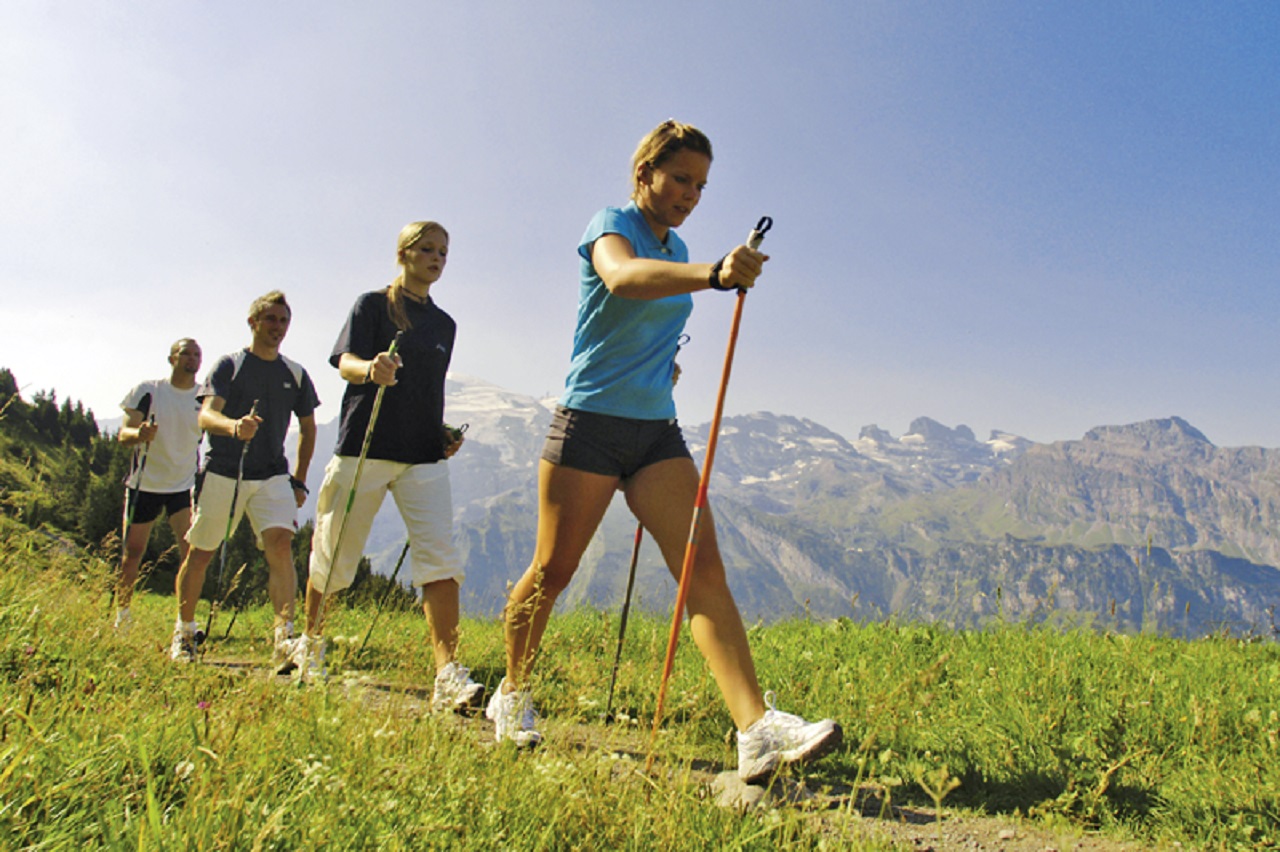
Your fitness app has probably been shouting the same thing at you for years: “Hit 10,000 steps!”
But a new line of research quietly says something else: if you can find 15 minutes a day to walk faster than usual, you may already be doing something powerful for your long-term health.
So powerful, in fact, that we decided TrailQuest should celebrate it.
Walking is great. Walking fast is a game changer.
A large study from Vanderbilt University Medical Center followed almost 80,000 adults — many from low-income, historically underrepresented communities — for about 17 years. When researchers compared people by how quickly they walked in daily life, they found something striking:
- Those who reported fast walking for roughly 15 minutes a day had a nearly 20% lower risk of dying from any cause.
- Those who mostly walked slowly, even for more than three hours a day, saw only about a 4% reduction in mortality.
In other words, it’s not just how long you walk — it’s how you spend a small slice of that time.
A short burst of brisk walking can beat a lot of slow, distracted steps.
from just 15 minutes of brisk walking a day.
Source: Vanderbilt University Medical Center, 2025 — ~80,000 adults followed for 17 years
What exactly is “brisk” walking?
The Vanderbilt study itself used self-reported categories like “fast walking” versus “slow walking”. That’s useful at scale, but your phone and watch need something more concrete.
Fortunately, other research has done that work. Harvard and other groups suggest that, for most adults, around 100 steps per minute is a good rule of thumb for moderate-intensity or “brisk” walking.
A couple of easy checks:
- You can talk in short sentences, but you’d struggle to sing.
- Your breathing is noticeably deeper, but the pace still feels sustainable for more than a few minutes.
That’s the definition we chose to build into TrailQuest.
- Brisk pace in TrailQuest: about 100 steps per minute.
- Brisk window: at least 15 minutes of that pace in a single day.
- Our detector: we look at your per-minute step data from Health (HealthKit / Health Connect) and scan for any 15-minute window that adds up to roughly 1,500 steps or more.
If we find such a window, your day counts as a Brisk Walk day.
Turning science into a daily Trail Wind boost
We didn’t want this to be just another hidden metric. If your heart and legs are doing the work, your in-game self should feel it too.
So we built a new system on top of your usual steps and streaks: Brisk Walk Reward.
Here’s what happens behind the scenes:
- Each day, TrailQuest quietly checks whether Health reports at least one brisk window (≈ 1,500 steps in 15 minutes) for today.
- If yes — and if you open the app that day — you automatically receive a Trail Wind boost into your inventory.
- You don’t have to start a special workout, tap “record”, or remember a hidden setting. Just walk briskly and open the app; we handle the rest.
Why Trail Wind? Because it fits the story: a short burst of focused effort in the real world becomes a temporary speed boost on your virtual journey — whether that’s through Middle-earth, to Santiago, or on any of the trails you’ll find in TrailQuest.
You’re moving faster across the map because you chose to move faster in real life.
Why we reward pace, not perfection
It’s easy to fall into all-or-nothing thinking:
“If I don’t hit 10,000 steps today, I failed.”
But that’s not what the data says.
Recent meta-analyses of step-count studies show that health benefits start to appear much earlier — around 4,000 steps a day already lowers mortality risk compared to very sedentary levels. The Vanderbilt work adds another important layer: even in communities without easy access to gyms or boutique fitness studios, short bouts of fast walking were strongly protective.
When we designed Brisk Walk Reward, we tried to encode three principles from this research:
- Small is big. Fifteen good minutes are better than zero perfect ones.
- Pace beats obsession. One focused brisk segment can deliver more health impact than hours of slow wandering.
- Accessible by design. You don’t need money, equipment, or a free evening. A fast lap around your neighborhood or office block absolutely counts.
TrailQuest should feel like a friend saying: “That fast walk you just did? It matters. Here’s a boost to prove it.”
How to earn your Brisk Walk Reward (without overthinking it)
The system is deliberately low-friction. You don’t need to micromanage cadence or stare at your watch. A few simple habits are enough:
- Pick one 15-minute “Brisk Lap” in your day. Your commute, a walk to pick up coffee, a loop after lunch, or a podcast walk in the evening — any of these can become your brisk window if you nudge the pace up.
- Use existing routines, don’t invent new ones. Walking meetings, school drop-offs, dog walks. The more your brisk time is tied to something you already do, the more likely it is to stick.
- Open TrailQuest the same day. We grant the reward once per day and we do it when you open the app. If you walked briskly but never open TrailQuest that day, the boost can’t be delivered.
- Aim for consistency over perfection. Our detector is tuned to roughly 100 steps per minute, but real life is noisy. What really matters is that most days have at least one intentional, fast walk.
What it feels like in the app
From the player’s perspective, the whole thing should feel simple and satisfying:
- You go for a short, fast walk — maybe on your way to work or during a quick break.
- Later the same day, you open TrailQuest.
- The app reads today’s step data from Health, finds a brisk segment, and adds a Trail Wind boost to your inventory along with a small inbox message celebrating your brisk day.
- On a day when you want your trail progress to feel a little more epic, you activate Trail Wind and watch your steps push you further.
Over time, your inventory becomes a subtle log of your “fast days” — each Trail Wind you stockpiled started as 15 minutes where you decided to pick up the pace.
Walking faster, living longer, playing better
The Vanderbilt researchers weren’t trying to design a game. They wanted to understand how everyday walking speed connects to long-term health, especially in people who rarely show up in clinical trials. Their message lines up closely with what we want TrailQuest to be:
- A low-pressure way to move more.
- Built on real science, not arbitrary numbers.
- Designed so that small, sustainable habits feel meaningful and rewarding.
Brisk Walk Reward is our first step in that direction: a direct bridge between a powerful, evidence-based health behaviour (15 minutes of brisk walking) and your virtual journey — whether that’s across Middle-earth, into Santiago, or along a trail you’ve never heard of yet.
Next time you head out the door, try this: pick one segment of your day, walk it just a bit faster than usual, and then open TrailQuest.
Your future self — and your trail avatar — will both thank you.
Walk faster. Go further. Play better.
TrailQuest turns your daily steps into real progress on legendary trails — Camino Françés, The Hobbit Trail, GR20 and more — with HealthSpan Score, Boosts, and trail lore. Free on Android.
▶ Get TrailQuest on AndroidSources: Vanderbilt University Medical Center (2025): fast walking and mortality in low-income adults. · Daily steps and mortality umbrella reviews in The Lancet and related journals (2019–2025). · Harvard Health (2018): cadence of ~100 steps/min as a practical benchmark for brisk walking.