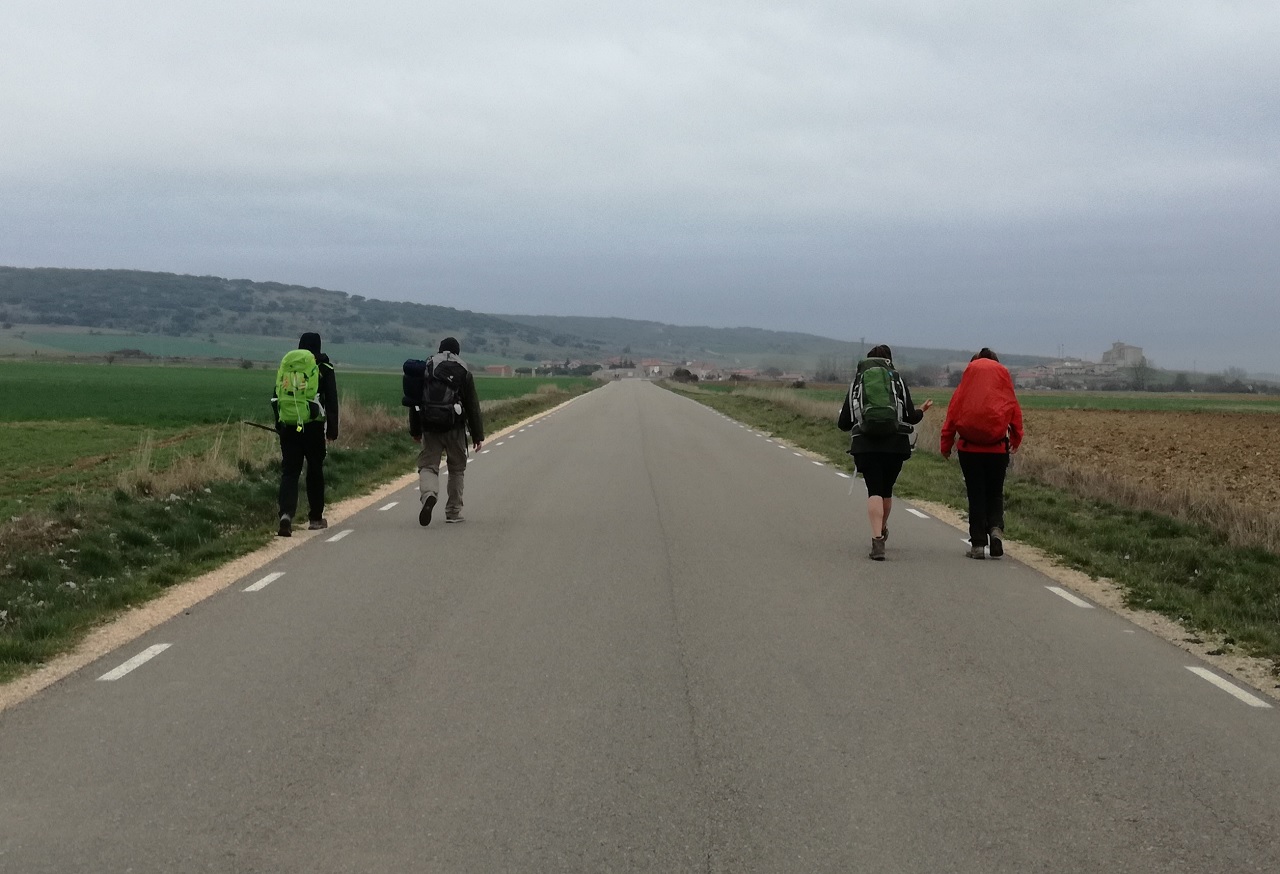
Anyone who has walked a long day on a trail knows the feeling.
On the Camino, it goes like this: boots off, a shower, the pilgrim dinner, and by ten o'clock the whole albergue dormitory is asleep, snoring included. On a mountain trek it comes even earlier. The sun drops behind the ridge, the air turns cold, you crawl into the tent, and you are gone before it is fully dark.
Nobody needs a podcast to drift off. Nobody lies awake scrolling.
It is tempting to conclude that walking is a sleeping pill. But a day like that also comes with eight hours outdoors, sunlight from morning to evening, a full stomach and no screens. Any of those could be doing the work.
Part I of this series looked at timing: the walk after a meal. This one asks a question almost everyone has an opinion on: does walking actually help you sleep, and does it matter when you do it?
The short answer is yes, a little. The more useful answer is in the details.
Why walking might help
There are three plausible explanations. All three are reasonable; none has been fully demonstrated for walking specifically.
- Sleep pressure. The longer you are awake and the more you do, the stronger the drive to sleep. Physical activity is thought to add to it.
- Daylight. Light is the strongest signal your internal clock uses to stay in step with the day. A walk outside during daylight is one of the simplest ways to get more of it.
- A calmer evening. Activity can lower tension and improve mood, and people who are less wound up tend to fall asleep more easily.
That is the theory. Here is what was actually tested.
A single walk, measured overnight
In 2019, researchers in Taiwan ran a small randomised trial with 40 women aged 55 and over who had mild sleep problems (Chen et al., Journal of Clinical Sleep Medicine). Half walked on a treadmill for 50 minutes at a light intensity; the other half rested quietly. Sleep was measured with a wrist-worn activity monitor for two nights before and two nights after.
After the walk, the walking group fell asleep 3.3 minutes faster on average, and their sleep efficiency (the share of time in bed actually spent asleep) rose by 3.8 percentage points. The resting group did not change.
Just as important is what did not change. Total sleep time, time awake during the night, and the number and length of awakenings were no different between the groups. The authors themselves called the effect "modest".
Ordinary days, ordinary people
A single lab session is one thing. What about normal life?
A study from Brandeis University followed 59 adults in the Boston area for four weeks while they took part in a programme to walk more (Sullivan Bisson et al., Sleep Health, 2019). They were not patients: average age 49, mostly women, recruited because they wanted to be more active. Each wore a simple step counter and rated their sleep every morning.
Two findings stand out:
- Day to day, within the same person: on days when someone was more active than their own average, they reported better sleep quality and longer sleep that night.
- Across the month: people with more active minutes rated their sleep quality higher, but did not sleep longer. The link was stronger in women than in men.
This matters because most sleep research focuses on people who already sleep badly. Here the participants were mostly ordinary adults, and the signal was still there.
The bigger picture
A 2015 meta-analysis pooled 66 studies on exercise and sleep (Kredlow et al., Journal of Behavioral Medicine). A single session of exercise had small benefits on several sleep measures. Regular exercise had small benefits on total sleep time and sleep efficiency, small-to-moderate benefits on how quickly people fell asleep, and moderate benefits on how well they rated their sleep.
Note the pattern: across these studies, the biggest effect shows up in how people feel about their sleep, not in hours on the clock. That matches the Boston study, too.
One caveat: this review covers exercise in general, not walking alone.
The evening walk: an old rule that doesn't hold up
For years, the standard advice was not to exercise in the evening because it would keep you awake. A 2019 review from ETH Zurich tested that rule (Stutz et al., Sports Medicine). It pooled 23 studies of healthy adults who did a single session of evening exercise and compared their sleep with a night without it.
The conclusion: the evidence does not support the idea that evening exercise harms sleep, "in fact rather the opposite". The one exception was vigorous exercise that ended an hour or less before bedtime, which may make it harder to fall asleep.
An easy walk after dinner is not vigorous exercise. If the evening is the only time you have, you don't need to give it up for the sake of your sleep.
Where daylight comes in
The daylight explanation has one memorable experiment behind it. In July 2013, researchers from the University of Colorado sent eight adults camping in the Rocky Mountains for a week, with no electric light at all (Wright et al., Current Biology). Before the trip, their internal clocks ran late. After a week of only natural light, the clock shifted earlier: the hormonal signal that the body's night is beginning arrived around sunset, and the internal night ended just after sunrise.
This was not a walking study, and eight people is a very small group. But it shows how strongly daylight sets the clock, and why an outdoor walk during the day is a plausible way to help it. It may also explain part of the tent scene at the start: after a full day of sunlight and no screens, your body's night really does begin earlier.
What this does not mean
- The effects are modest. Three minutes faster to fall asleep is real, but nobody would notice it on a single night.
- The samples are small and specific. Forty older women with mild sleep problems; 59 mostly female adults in one city; eight campers. None of this tells you how big the effect will be for you.
- Much of it is self-reported. The Boston study relied on how people rated their own sleep, and it shows an association between active days and better nights, not proof that one caused the other.
- It is not a treatment. None of these studies tested walking as a cure for insomnia, sleep apnoea or other sleep disorders. If poor sleep lasts for weeks, see a doctor.
Should you care if you already sleep fine?
Honestly, the gain may be small. If you sleep well, walking will not turn a good night into a spectacular one.
But the Boston study is the reassuring part: in mostly ordinary adults, more active days went with nights people rated as better. And the evening-exercise review removes a common reason not to walk. Better sleep is not a reason to add another rule to your day. It is a likely side effect of walking you would do anyway.
Your 7-day experiment
Keep it simple:
- Walk every day, at whatever time fits. If you can, make at least part of it outdoors in daylight. If the evening is your only window, an easy evening walk is fine.
- Each morning, write three short lines: what time you went to bed, roughly how long it took to fall asleep, and how rested you feel (1 to 5).
At the end of the week, compare your notes with your memory of the week before. You are not running a clinical trial. You are just finding out whether the effect researchers measured shows up in your own nights.
Previously ← Part I: The Walk After the Meal — why a short walk after eating changes how your body handles the meal.
Next in the series → Part III: Do You Have to Walk Every Day? What large studies say about walking on some days but not others.
Related: Walking is the sixth vital sign.
Not every night can be an albergue or a tent
But your everyday steps can still take you along the Camino Francés, the GR20 or the road from the Shire to the Lonely Mountain. TrailQuest counts the steps from your phone and turns them into progress on a real trail, kilometre by kilometre — handy for the 7-day experiment, too. Free on Android.
▶ Get TrailQuest on Google Play