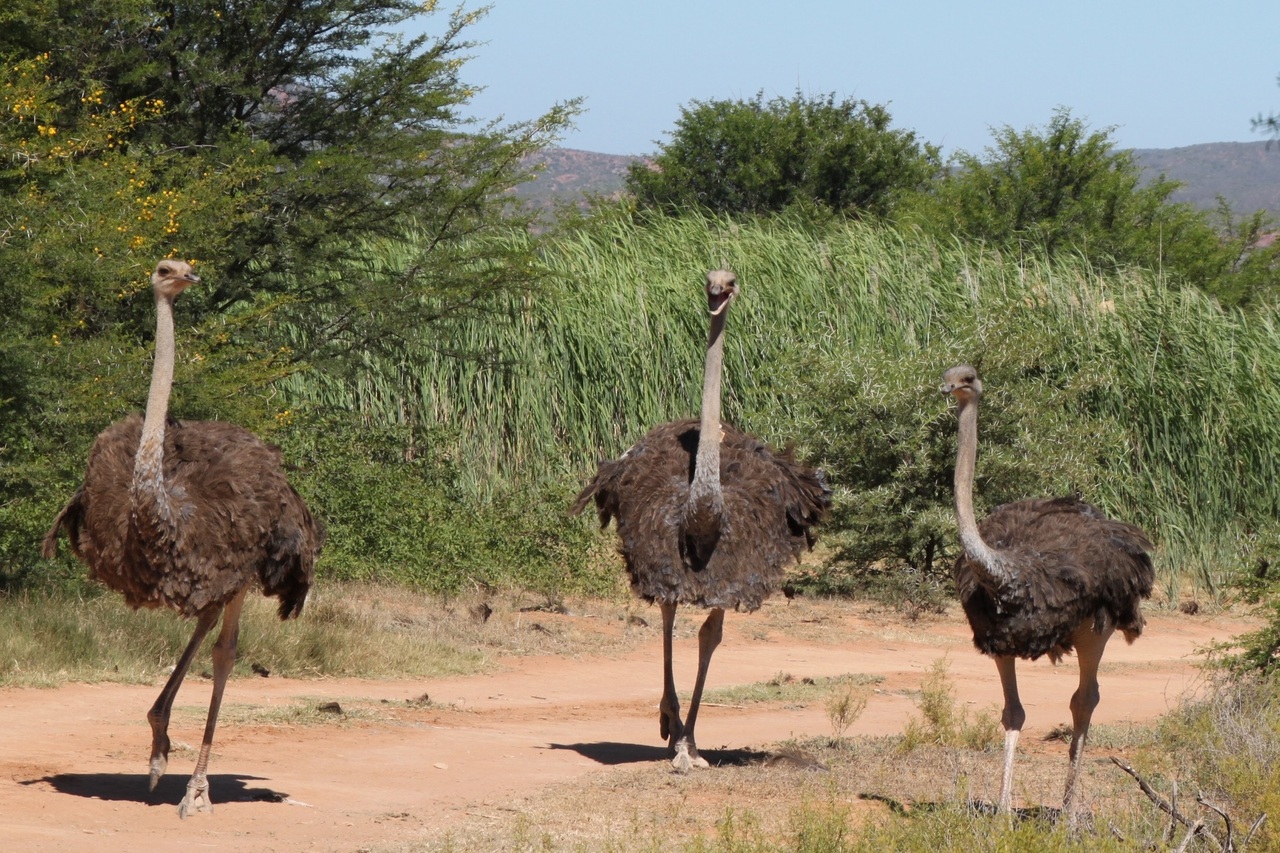
An ostrich runs at ~70 km/h on two legs — faster than any human will ever sprint. Bipedalism isn't rare, and it isn't ours to brag about. What made us different was never the legs.
You are not the only animal that walks on two legs. You're not even a particularly good one.
An ostrich will run you into the ground — roughly 70 km/h, on two legs, for far longer than you could hold a sprint. A kangaroo's tendons spring it along so efficiently that going faster barely costs it anything. Even a cockroach, when it really needs to move, rears up and runs on its back legs. Bipedalism isn't rare, and where it turns up, it's often better than ours.
So if two legs aren't the special thing — and they aren't — what is? Part I was about how we came to stand up. Part II was about what that did to the brain. This one is about the comparison we keep getting wrong: what actually separates human walking from every other animal that moves. The answer isn't in the legs at all.
A quick tour of the other bipeds
Birds are the great bipedal success story — but look at what their front limbs are doing. They're wings. Committed, full-time, to flight. A bird's "hands" quit the manipulation business hundreds of millions of years ago and never came back.
Kangaroos hop, and it's gorgeous engineering — elastic tendons storing and returning energy so that speeding up is nearly free. But hopping isn't walking, and those little forelimbs are there for balance and grazing, not much else.
And our own closest relatives? Chimpanzees and gorillas can stand and shuffle upright, but they don't stay there. They knuckle-walk — and on the rare occasions they go bipedal, it costs them dearly. A chimp burns roughly four times the energy we do to cover the same ground (that figure from Part I). For an ape, two legs is a part-time, expensive posture. They always drop back to four.
Sockol, Raichlen & Pontzer, 2007
Human walking — the striding, inverted-pendulum gait we met in Part I — is biomechanically its own thing. But that's still not the headline. The headline is what happened to the limbs that stopped walking.
The dividend no other biped collected
Every other two-legged animal kept its front limbs on the payroll. Birds turned them into wings. Kangaroos kept them for balance. Apes borrow two legs now and then and hand the job straight back to four. In every case the forelimbs stayed committed — to flying, to balancing, to part-time walking.
We are the only lineage that took the front limbs off locomotion permanently and never gave them back. We stood up, and we stayed up. And that left two remarkably capable limbs with nothing to do — free to become something that moving on all fours could never have allowed. Hands.
That's the real difference. Not that we walk on two legs, but that we're the only two-legged animal that never needed the other two for getting around again. The hand is the dividend of full-time bipedalism — and we're the only species that ever collected it.
What a free hand becomes
A limb that no longer has to carry your weight can afford to get delicate.
The human hand is built for a trick most animals simply can't do: the precision grip — thumb pressed against fingertips. It's the grip you're using to hold your phone, thread a needle, or shape a stone tool. The anatomist John Napier drew the line decades ago between the power grip (a fist around a hammer) and the precision grip (a pen between fingertips). Plenty of animals have the first. We are in a league of our own at the second.
But a hand is only as good as the wiring that runs it — and that's the second half of the story. In most mammals, a surprising amount of walking is handled low in the nervous system: networks in the spinal cord that generate the basic rhythm of stepping largely on their own, with the brain mostly steering rather than issuing every command. Cats and dogs lean heavily on these spinal "pattern generators." It's the unsettling reason a chicken can keep running for a moment after it loses its head — the rhythm of running was never in its head to begin with.
We're wired differently. Humans have unusually direct lines from the motor cortex straight down to the neurons that drive the hand — a more brain-heavy control system that lets us move fingers one at a time, deliberately (Lemon, 2008). More of the brain sits inside every skilled movement. Which is precisely the coupling Part II was about: in us, moving and thinking run on the same wiring — and nowhere is that knot tighter than in the hand.
So what actually makes us unique? (Careful here.)
This is the point where it's tempting to end on a flourish about human specialness. Resist it. The science has.
Because every piece of this turns up somewhere else. Chimps fish for termites with stripped twigs. New Caledonian crows bend hooked tools and reason about how to use them. Animals all over the tree of life plan routes, carry mental maps, cooperate in groups. Pull on any single thread — bipedalism, tool use, big brains, planning — and you'll find another species holding the other end. There is no one trait, no bright line, no spark that lives in us and nowhere else.
What's genuinely rare isn't any of the parts. It's the stack: an efficient striding gait, plus front limbs retired into precision hands, plus a large, relentlessly social brain wired straight into those hands, plus — eventually — language, all converging in one lineage at once. Evolutionary science has quietly stopped hunting for the thing that makes humans not-animals. We are animals. We just happen to be an unusual pile-up of otherwise ordinary parts.
The question was never who walks best
Ostriches walk better. Kangaroos travel cheaper. That was never the interesting question.
The interesting question is what became possible when one primate stood up, took its front limbs off the ground for good, grew a hand delicate enough to make things — and ran a wire from its brain straight into that hand.
And that package doesn't arrive fully formed. You can watch it assemble, piece by piece, in a single human being — in the first year of a life, in the oddly specific order that standing, walking, pointing, and the first words show up. That's Part IV.
Sources
Alexander, R. McN. (2004). Bipedal animals, and their differences from humans. Journal of Anatomy, 204(5), 321–330.
Sockol MD, Raichlen DA, Pontzer H (2007). Chimpanzee locomotor energetics and the origin of human bipedalism. PNAS, 104(30), 12265–12269.
Napier JR (1956). The prehensile movements of the human hand. Journal of Bone & Joint Surgery, 38-B(4), 902–913.
Lemon RN (2008). Descending pathways in motor control. Annual Review of Neuroscience, 31, 195–218.
Grillner S, et al. (1988). Locomotor behavior and control in human and non-human primates: comparisons with cats and dogs.
Roberts AM, Thorpe SKS (2014). Challenges to human uniqueness: bipedalism, birth and brains. Journal of Zoology.
Every step is 7 million years of evolution — and a hand no other animal ever got.
TrailQuest turns your daily walks into a journey along the world's greatest long-distance trails — with science-backed insights, trail lore, and streaks that keep the habit alive. Free on Android.
▶ Get TrailQuest on Android