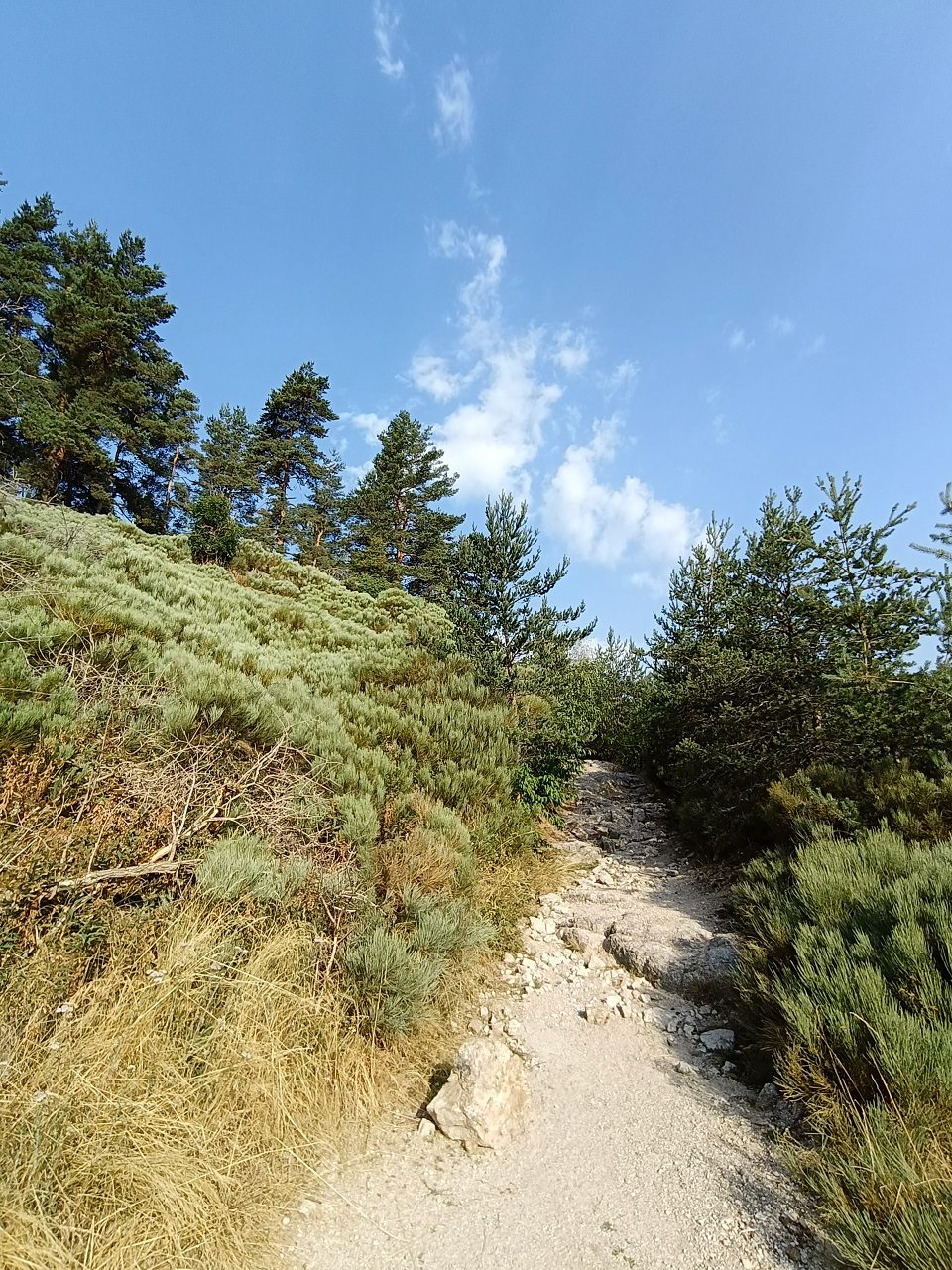
On the Via Podiensis (GR 65) in the Margeride, Lozère.
Every morning, my Healthspan Score went down.
I hadn’t done anything wrong. I’d slept. But the score counted today in its seven-day average, and at seven in the morning today has almost no steps. By the evening it recovered. The next morning it dropped again.
That was one of four things I didn’t like about the score. Version 1.3.8, out now on Google Play, fixes all four. The new score is fairer and smoother, and it pays attention to something the old one ignored: how fast you walk.
It’s also stricter. Most of you will see a lower number after the update. That isn’t because you walk less. The scale changed, and below I explain why.
What Was Wrong With the Old Score
The Healthspan Score has always tried to answer one question: is the way you walk the kind of walking that research links to a longer, healthier life? It was built from three parts: how much you walk, how regularly, and how much you climb.
The idea was right. The arithmetic had four problems.
- The morning dip. Today was part of the average from the first minute of the day, so the score fell every morning and climbed back by the evening.
- Jumps. The steps part had eight steps of its own. Going from 6,999 to 7,000 steps a day was worth eight points at once. Below 3,000 steps everyone got the same 10 points, whether they walked 300 steps or 2,900. That isn’t what the science looks like. The research shows a smooth curve, steepest at the low end.
- Climbing barely mattered. Five points at most.
- Pace didn’t matter at all. And that one was on us.
The New Score: Four Parts, 100 Points
| Part | Points | How you get them |
|---|---|---|
| Dose | 55 | Your average daily steps over 7 days. Points grow with every 100 steps. |
| Consistency | 28 | 2 points for every day with at least 7,000 steps in the last 14 days. |
| Hiking | 10 | 1 point for every 100 m you climbed in the last 7 days. 1,000 m is full. |
| Brisk walk | 7 | 1 point for every day of the last 7 with a brisk walk. |
Dose follows the curve from the research behind our 7,000-steps article: the gain is steepest up to about 6,000 to 8,000 steps a day, and it keeps growing after that, just more slowly. Every 100 steps now moves you a little, and the score changes one point at a time, never eight. 12,000 steps a day gets the full 55.
Consistency keeps its fixed threshold of 7,000 steps. It doesn’t depend on your own daily goal. If your daily goal is 5,000 steps, TrailQuest will cheer when you reach it, but the Healthspan Score still measures you against the same evidence as everyone else. That’s what makes it comparable on the leaderboard, and honest.
Brisk walk is new, and it’s a debt we’ve finally paid.
We’ve known for a long time that pace matters. A large Vanderbilt study followed almost 80,000 adults for 17 years. About 15 minutes of fast walking a day went with almost 20% lower mortality. Hours of slow walking went with about 4%. That’s why, back in June, we added the Trail Wind reward for brisk walks: walk 15 minutes at about 100 steps a minute, and you get a free Trail Wind boost.
The game rewarded your pace. The Healthspan Score, the one number meant to reflect your health, didn’t see it at all. Now it does.
A brisk-walk day is a day with at least 15 minutes at about 100 steps a minute, the same rule as the reward. The score reads these days straight from your step data in Health Connect, so you don’t have to open the app on the day, and it doesn’t matter whether you had room for the Trail Wind boost.
Hiking now counts double what it did, and climbing 1,000 m in a week gets you all ten points.
Put together, the score now looks at four things: how much you walk, how regularly, how fast and how much you climb. Each of them on the scale the research gives it. As far as we know, no other walking score reads all four from your own walking. That makes the Healthspan Score the most complete measure there is of what your walking does for your health.
No More Morning Dip
Every part of the score now takes the better of two windows: the last full days ending yesterday, or the same window with today in place of the oldest day. Today counts only when it raises your score.
So during the day your score can only go up. A brisk walk at lunch adds its point the same afternoon. At midnight the oldest day leaves the window, and then the score can go down. That’s real: a week ago really is no longer this week.
Why Your Score Is Probably Lower
Here’s how the same weeks score on the old and the new scale:
| Walker | Old | New |
|---|---|---|
| 10,000 steps a day, every day, flat, no brisk walks | 94 | 80 |
| The same, with a brisk walk every day | 94 | 87 |
| 7,500 a day, 10 of 14 days, 400 m climbed, 4 brisk days | 86 | 73 |
| 5,000 a day, 3 of 14 days, flat, no brisk walks | 50 | 38 |
Walking a lot on flat ground used to be enough for a top score. Now the top needs everything the research rewards: enough steps, every day, a bit of pace and a bit of climbing. A brisk walk every day brings a strong walker most of the way back.
Not everyone loses. If you walk little, the new score is kinder. The flat 10 points below 3,000 steps are gone, and the curve pays from the first 100 steps. A day with no steps at all now scores 0, not 10.
The zones stay where they were: Low below 25, Building below 55, Optimal below 80, Peak from 80 up.
My own score went from 99 to 98: 55 for steps, 28 for consistency, 8 for climbing and 7 for brisk walks. I was lucky to have climbed 800 m that week. Without it I would have lost more.
Climbing Needs a Watch or a Band
Most phones don’t send how much you climbed to Health Connect. Elevation gets there mainly from a watch or a fitness band.
If TrailQuest finds no elevation data at all, it now says so, “No elevation data in Health Connect”, instead of showing 0 m as if your week had been flat. To earn hiking points, connect a watch or band that measures elevation and sync it with Health Connect.
Your History, and the Leaderboards
- Your 14-day chart is recalculated on the new scale the first time you open 1.3.8, so it doesn’t jump on update day.
- Your best score starts over. A best score from the old scale couldn’t be beaten on the new one, so your first 2.0 score replaces it.
- The Healthspan leaderboards show only 2.0 scores. Scores from two different scales can’t be ranked against each other, so friends who haven’t updated yet disappear from them until they do. If someone is missing, tell them to update.
Also in 1.3.8
- The Trail Wind reward for a brisk walk comes faster. The check used to read your steps minute by minute and could take a while. Now it’s one quick read.
- + Add on other walkers’ profiles. When you open the profile of someone who isn’t your friend, from a leaderboard or the map, you’ll see + Add instead of Cheer and Send gift, which only friends can use.
- Smaller fixes, including the step count after restoring your account on a new phone.
Update TrailQuest
And take a 15-minute brisk walk today. You’ll get the Trail Wind boost, as before. And now your Healthspan Score will show it by the evening too. Free on Android.
▶ Get TrailQuest on Android