Most free apps come with one of two catches: ads or a paywall. Your attention sold to advertisers, or your access sold back to you in pieces. TrailQuest has neither. That’s not a happy accident — it’s the first design decision I made, and it shapes everything that came after.
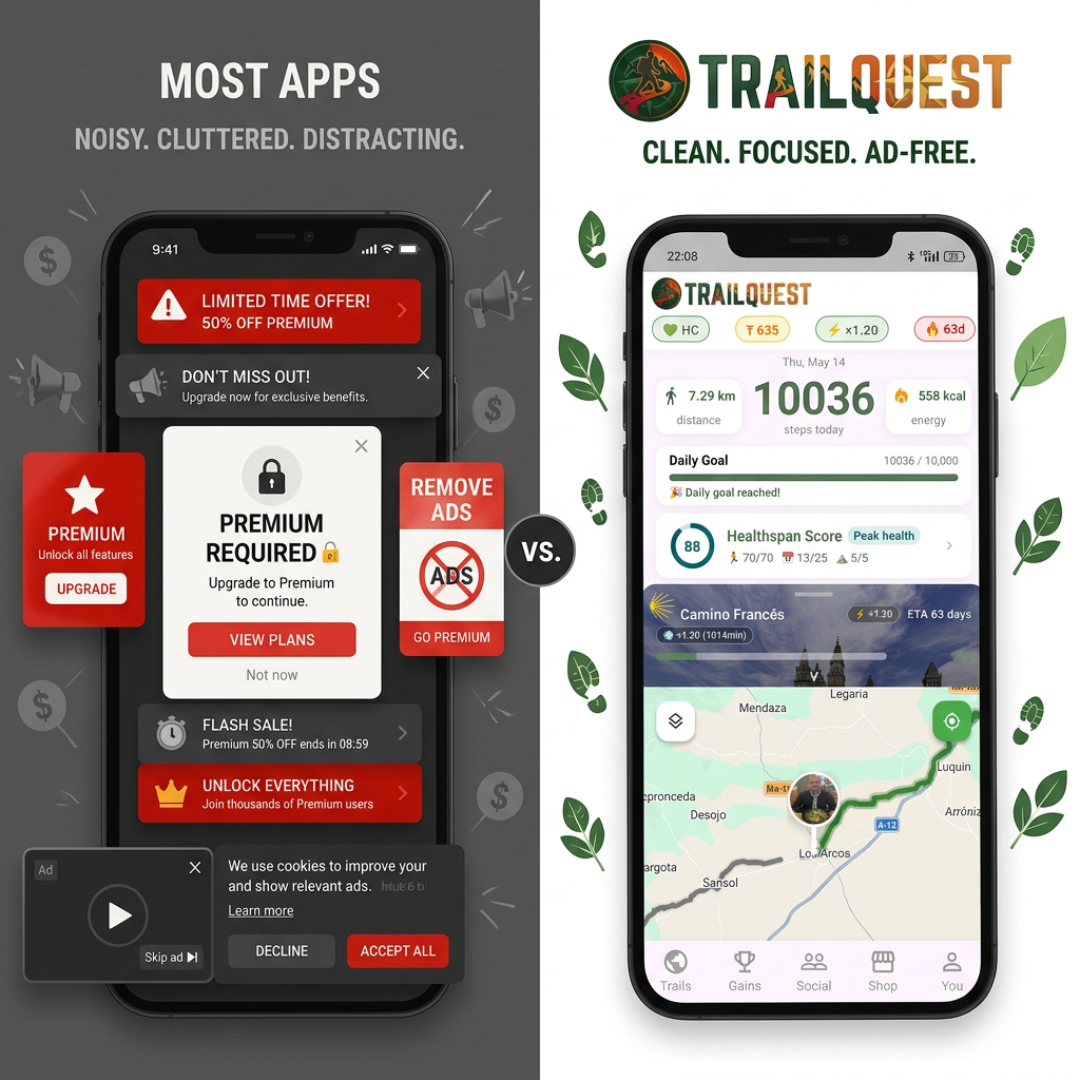
The standard playbook — and why I rejected it
Ad-funded apps need one thing above all else: time spent in the app. More screens, more sessions, more notifications. The metric that matters is engagement — which sounds healthy, but usually means the opposite.
Paywall apps have a different problem. When core features sit behind a subscription, the product’s incentive is to make the free experience just frustrating enough to push you over the line. The friction is the point.
A walking app built on either model faces the same fundamental contradiction: it doesn’t actually need you to walk. It needs you to open it, to scroll it, to feel bad enough about the locked features to pay. Those are very different goals, and they produce very different products.
🔉 Ad-funded app
- Needs you to open the app
- Optimises for session length
- Your behaviour is the product
- More notifications = more revenue
🏃 TrailQuest
- Needs you to walk outside
- Optimises for steps taken
- Your progress is the product
- Fewer open-app moments = success
“The best walking app is one that sends you outside — not one that keeps you staring at your phone.”
What I built instead
TrailQuest is free. Every trail, every feature, every health metric — free. No content locked behind a subscription. No features stripped out to create upgrade pressure.
TrailQuest makes money one way: Trail Coins. You earn them by walking — completing your daily goal, hitting milestones, finishing trails. If you want to move faster than your steps allow, you can buy more. That’s it. IAP sells time, not access. Every user can reach everything — they just have to walk for it.
and every health tool in TrailQuest.
Forever.
The overjustification problem
There’s a well-documented psychological phenomenon called the overjustification effect. When you introduce external rewards — money, prizes, ad-driven gamification — for something a person already does for internal reasons, their intrinsic motivation drops. The external reward replaces the internal one.
Ads are the purest form of this. They signal to your brain: this app is here to extract value from you. That signal quietly corrodes the genuine motivation that walking can produce on its own. A paywall does something similar — it reframes a health habit as a transaction.
I never introduced either. Not because I couldn’t make it work financially, but because I didn’t want TrailQuest to feel like a slot machine or a subscription you forget to cancel. I wanted it to feel like a trail companion.
What it means in practice
The honest trade-off
This model is harder to build. Ad revenue is reliable and scalable. Paywalls convert predictably. Earning trust walk by walk is not.
I have to ship features that genuinely move people — literally — or nobody earns Trail Coins, nobody buys them, and the whole thing falls apart. I think that’s the right constraint. Every feature has to answer the same question: does this actually help people walk more? Not: does this increase session length?
That’s how I want to build TrailQuest. Walk by walk, feature by feature, post by post — and without ever selling your attention to pay for it.
Further reading
Deci, E. L. (1971). Effects of externally mediated rewards on intrinsic motivation. Journal of Personality and Social Psychology, 18(1), 105–115.
Deci, E. L., & Ryan, R. M. (2000). The “What” and “Why” of Goal Pursuits. Psychological Inquiry, 11(4), 227–268.
🏃 Start walking. No ads. No paywall.
Every trail, every feature, every health tool — free. Your steps are all you need.
▶ Get TrailQuest on Android